

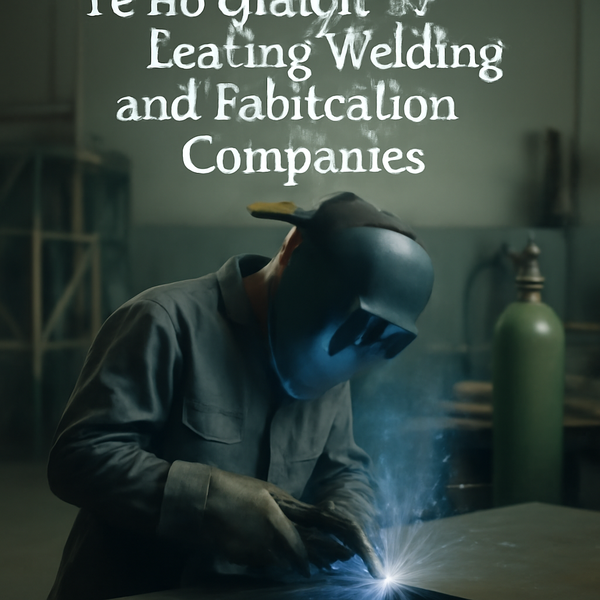
Explore exciting career opportunities within the dynamic world of welding and fabrication. If you're seeking to join a team that values skill, precision, and innovation, understanding the landscape of top welding and fabrication companies is your first step. Discover companies known for their cutting-edge projects, commitment to safety, and growth potential for skilled professionals in this essential industry.
The Growing Demand for Skilled Welders and Fabricators
The welding and fabrication industry is a cornerstone of modern manufacturing and construction, providing the essential building blocks for everything from skyscrapers and bridges to advanced aerospace components and automotive vehicles. Consequently, the demand for skilled professionals in this field remains consistently high. Companies specializing in fabrication are constantly seeking individuals with a strong understanding of welding techniques, blueprint reading, and material properties. This demand is fueled by ongoing infrastructure projects, the expansion of manufacturing sectors, and the continuous need for repair and maintenance of existing structures. Entry-level positions often provide opportunities for on-the-job training, allowing aspiring professionals to develop specialized skills under experienced mentors. As you gain experience and certifications, career paths can lead to supervisory roles, quality control, or even specialized welding disciplines such as TIG welding for high-precision work or pipe welding for critical infrastructure. The industry's reliance on technology also means that familiarity with automated welding processes and robotic systems is becoming increasingly valuable, opening up new avenues for career advancement and higher earning potential.
Key Sectors Relying on Fabrication Expertise
Fabrication companies are integral to a vast array of industries, each with its unique demands and specifications. The construction sector, for instance, relies heavily on structural steel fabrication for commercial buildings, residential complexes, and public infrastructure. Think of the intricate steel frameworks that support towering skyscrapers or the robust beams that form bridges – all brought to life through expert fabrication. In the energy sector, fabrication plays a crucial role in building pipelines for oil and gas, creating components for renewable energy sources like wind turbines and solar panel mounts, and manufacturing equipment for power plants. The automotive industry utilizes fabrication for everything from chassis assembly to the production of specialized vehicle parts. Furthermore, the aerospace industry demands the highest levels of precision and quality in fabricating aircraft components, from fuselage sections to engine parts, often using advanced materials and techniques. Even in sectors like shipbuilding and heavy equipment manufacturing, the foundational work of cutting, shaping, and joining metal is the domain of skilled fabricators, highlighting the pervasive and essential nature of this craft across the global economy.
Advancements in Welding and Fabrication Technology
The landscape of welding and fabrication is continually evolving, driven by technological advancements that enhance efficiency, precision, and safety. Automated welding systems, including robotic arms equipped with advanced welding heads, are becoming increasingly common, allowing for faster production cycles and consistent, high-quality welds. These systems are particularly beneficial for repetitive tasks or in environments that may be hazardous for human workers. Furthermore, the development of new welding consumables and filler materials has expanded the range of metals that can be effectively joined, including advanced alloys and composites. Non-destructive testing (NDT) methods are also becoming more sophisticated, employing ultrasonic, radiographic, and magnetic particle inspection techniques to ensure the integrity and strength of welds without compromising the material. The integration of digital technologies, such as advanced CAD/CAM software for design and programming, and augmented reality (AR) for training and on-site guidance, is further revolutionizing the field. These innovations not only improve the quality of the final product but also create new skill requirements for the workforce, emphasizing the need for continuous learning and adaptation within the industry.
Navigating Your Career Path in Fabrication
Embarking on or advancing a career in welding and fabrication requires a strategic approach to skill development and professional networking. For those new to the field, formal training through vocational schools or community colleges offers a solid foundation in welding techniques, safety protocols, and blueprint interpretation. Apprenticeship programs provided by established fabrication companies are invaluable, offering paid, hands-on experience alongside mentorship from seasoned professionals. Obtaining relevant certifications, such as those from the American Welding Society (AWS), can significantly boost your employability and earning potential, demonstrating your proficiency in specific welding processes and standards. Networking plays a vital role; attending industry trade shows, joining professional organizations, and actively engaging with colleagues and employers can open doors to new opportunities and insights. Continuously updating your skillset to include emerging technologies, such as advanced automation or specialized welding processes, is crucial for long-term career growth. Many fabricators also progress into roles like welding supervisors, quality inspectors, or even business owners, leveraging their technical expertise and industry knowledge.
What Leading Companies Look For
Leading welding and fabrication companies are consistently seeking individuals who possess not only technical proficiency but also a strong work ethic and a commitment to safety and quality. Demonstrable skills in various welding processes, such as Stick (SMAW), MIG (GMAW), TIG (GTAW), and Flux-Cored (FCAW), are fundamental requirements for many positions. A keen eye for detail, the ability to interpret complex technical drawings and specifications, and proficiency in using precision measuring tools are equally important. Employers highly value candidates who prioritize safety in the workplace, adhering strictly to established safety procedures and regulations to prevent accidents and injuries. Furthermore, a willingness to learn, adapt to new technologies, and work effectively as part of a team are crucial attributes. Companies often look for problem-solving abilities, as fabricators frequently encounter unique challenges that require innovative solutions. Experience with different types of metals and alloys, as well as knowledge of post-weld treatments and inspection techniques, can also set candidates apart. Soft skills, such as good communication and punctuality, are also key indicators of a reliable and valuable employee in this demanding industry.